
Playa Rocio, Puerto Banus €749,000
A vibrant marina blending luxury, culture, and celebrity in Marbella, with exclusive dining, nightlife, and stunning views.
Updated · 25 min. read Published
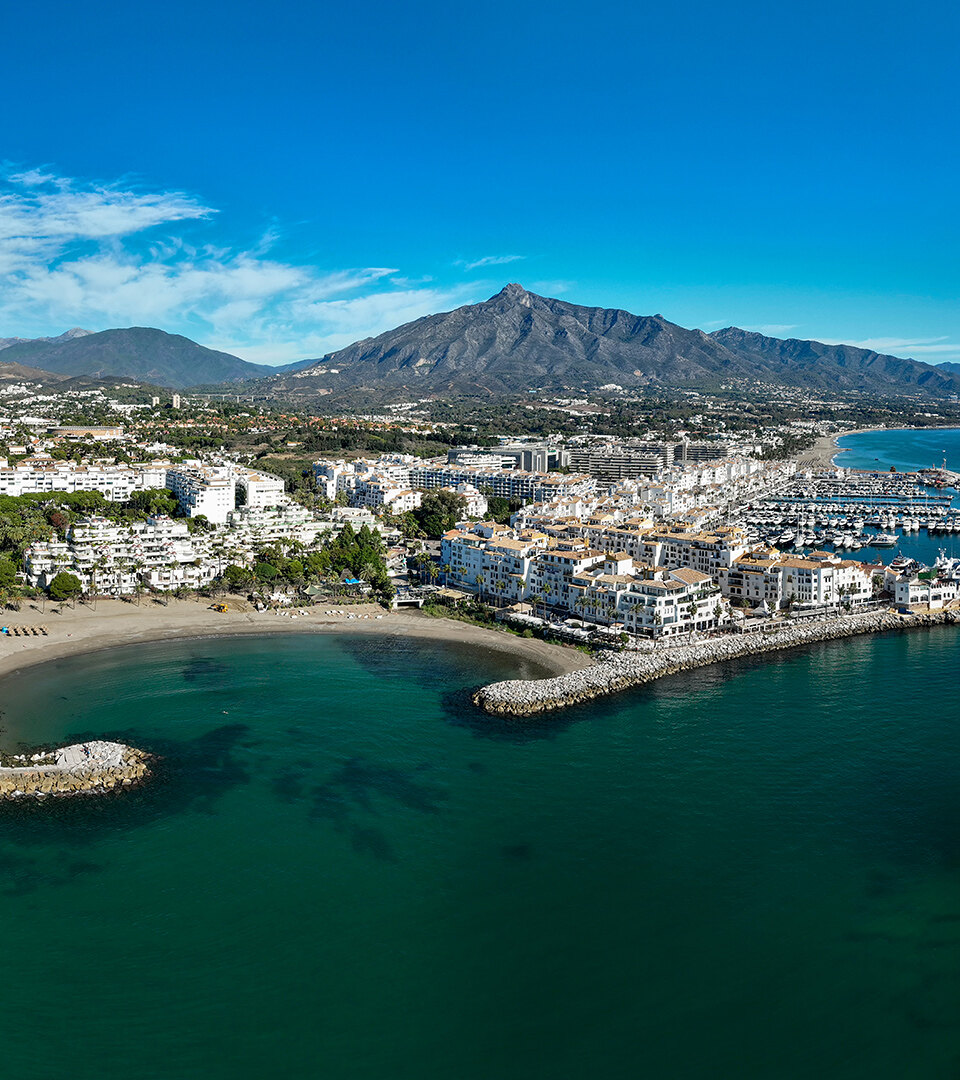
Puerto Banús is the crown jewel of the Costa del Sol — a Mediterranean marina that draws almost 5 million visitors a year to its 915-berth harbour, designer boutiques and 320 days of sunshine. But beyond the glamour, it’s also one of southern Europe’s most coveted addresses for buyers: gated frontline-beach communities, championship golf at the Nueva Andalucía Golf Valley, and an international community served by world-class schools and hospitals.
This guide, written by Panorama Properties Marbella — RICS-regulated and operating in the area since 1970 — walks you through everything you need to know before buying, renting or moving to Puerto Banús: the neighbourhoods, the property market, the lifestyle, and the practicalities.
| Feature | Detail |
| Location | Marbella, Costa del Sol (Málaga, Andalucía) |
| Climate | 320 days of sunshine · avg. 18 °C annual |
| Sea temperature | 19 °C average · swim April–October |
| Marina | 915 berths · vessels 8–50 m |
| Annual visitors | 5 million |
| Málaga Airport | 60 km · 45 min via AP-7 |
| Marbella Old Town | 8 km |
| Golf | 3 championship courses within 5 km |
| International schools | Aloha College, Swans, Laude San Pedro |
| Security | 24/7 private patrols · gated communities |
| Connectivity | 1 Gbps fibre optic |
| Residency | Multiple visa pathways for non-EU buyers |
Puerto Banús is located on the southern coast of Spain, in the municipality of Marbella (province of Málaga, Andalusia), halfway between the historic centre of Marbella and San Pedro de Alcántara. The marina is easily accessible from Málaga–Costa del Sol Airport (60 km, approximately 45 minutes via the AP-7 motorway) and from Gibraltar Airport (just over an hour’s drive to the west).


Until the late 1960s, the stretch of Costa del Sol shoreline between Marbella's old town and San Pedro de Alcántara was little more than fishermen's huts, sugar-cane fields and almond groves. Marbella itself was a sleepy town of around 12,000 inhabitants, only beginning to attract a trickle of well-heeled European travellers drawn by Prince Alfonso de Hohenlohe's pioneering Marbella Club, founded in 1954.
The transformation came in May 1970, when local developer José Banús opened a marina that would redefine luxury tourism in southern Europe.

In 1966, Prince Alfonso de Hohenlohe invited Swiss architect Noldi Schreck — who had previously contributed to the design of Beverly Hills — to work on the Marbella Club.
Schreck's first task was to meet José Banús and persuade him to abandon his original plan: high-rise towers along the waterfront, designed to house thousands of wealthy families.
Together with the young Mexican-Spanish architect Marcos Sainz, Schreck proposed something radically different: a low-rise marina shaped like a traditional Andalusian pueblo blanco, with whitewashed buildings, terracotta tiles and narrow streets opening onto the quayside.
Banús accepted the vision, and the result became the first marina in the world designed end-to-end by a single architectural team.
That decision — to build a village rather than a wall of concrete — is the single reason Puerto Banús still looks and feels the way it does today.
The marina opened in May 1970 with a guest list that read like a Vanity Fair cover: Prince Rainier and Princess Grace of Monaco, the Aga Khan, Roman Polanski, Hugh Hefner, and a young Julio Iglesias singing for the 1,700 guests. Three hundred waiters from Seville served 22 kilos of beluga caviar. The tone was set from day one.

What began as a 15-hectare marina with 915 berths evolved into a year-round destination drawing nearly five million visitors annually. The Saudi Arabian Royal Family built a palace on its outskirts; Sean Connery, Antonio Banderas, Kate Moss and countless others became regular faces. The streets are filled with Dior, Gucci, Bulgari, Versace and Dolce & Gabbana, and one stretch earned the nickname "The Golden Mile of shopping".
Yet Puerto Banús never lost its dual personality. Behind the supercars and the super-yachts, the morning market still sells olives and ceramics, families still walk the quay with ice cream, and the original Andalusian arches still frame the view of La Concha mountain rising behind. It remains, as it was designed to be, a village — only with a slightly more glamorous postcode.
Find out more about the history of Puerto Banús & Nueva Andalucía.
Jump to Lifestyle and amenities or Neighbourhoods within Puerto Banús.

Panorama was already selling property around Puerto Banús in 1968, before the marina officially opened and two years before Panorama established its first office in Marbella.
After arriving in Marbella in 1973, Managing Director Christopher Clover met José Banús personally on three occasions, giving him a first-hand impression of the developer behind
Puerto Banús and the wider transformation of this part of the coast.
Christopher remembers Banús as:
“a wonderful guy — very rough, ready”
Christopher Clover
The recollection offers a glimpse of the personality behind the marina. Banús had set out to transform a largely undeveloped stretch west of Marbella into a new marina and residential destination on an extraordinary scale. A vision that would ultimately reshape this entire part of the coast.
Puerto Banús is one of the few Mediterranean addresses where a resort ambience meets metropolitan convenience. Sheltered by the dramatic peak of La Concha, the marina enjoys its own sunny micro-climate — low humidity, balmy winters and cooling sea breezes in midsummer. Morning temperatures rarely dip below 13 °C, so you can jog the seafront or play a dawn round of golf while much of Europe shivers.

Puerto Banús's dining scene is one of the most international on the Spanish coast. The quayside is lined with classic marina restaurants such as Cipriani, Picasso, La Pappardella and the legendary Salduna Beach, while inland the gastronomic offer ranges from authentic Andalusian tapas to Japanese omakase. Beach clubs like Ocean Club Marbella and Trocadero Arena define the summer scene with sunset DJs and long, leisurely lunches.
For more refined dining, the Michelin Guide lists several recommended restaurants within a 10-minute drive, including Skina (two Michelin stars) in Marbella's old town and Messina (one star). Closer to home, the Nueva Andalucía dining triangle — just inland from the marina — offers some of the best-value fine dining in the area.
You might find this interesting: Michelin-Star Magic: Fine Dining Experiences in Marbella.
Puerto Banús's narrow streets and quayside arcades house one of the densest concentrations of luxury boutiques in southern Europe. Louis Vuitton, Dior, Gucci, Versace, Dolce & Gabbana, Bulgari and Hermès all maintain flagship stores here, with newer arrivals from Brunello Cucinelli and Tom Ford in the surrounding streets.
The El Corte Inglés department store on Antonio Banderas Square anchors the practical side of shopping, with the upscale Hipercor hypermarket on the ground floor. Every Saturday, an open-air market on the western edge of the marina draws crowds for handmade leather goods, ceramics, art and Spanish delicacies.

Puerto Banús's after-dark scene is one of the most vibrant on the Mediterranean. Iconic venues like Olivia Valère, Pangea, Tibu and Aqwa Mist attract an international crowd from late spring to early autumn, while waterfront cocktail bars on the quay stay busy year-round. Ocean Club sets the standard for daytime party brunches, and Sala Beach delivers polished waterfront dining well into the night.
The energy is concentrated in summer, but unlike many Costa del Sol resorts, the marina's bars and restaurants stay open all year — a quiet luxury for residents who want a winter dinner with a sea breeze.
Two leading private hospitals — Quirónsalud Marbella and HC Marbella International Hospital — sit within a 15-minute drive, complemented by dozens of English-speaking clinics, dentists and aesthetic-medicine practices. Boutique gyms, padel clubs, beach yoga and Pilates studios are scattered throughout the area.
Families relocating to Puerto Banús benefit from one of Europe's strongest concentrations of international schools within easy reach:
Further information: Top 7 International Schools in Marbella.

Puerto Banús sits at the gateway to the Nueva Andalucía Golf Valley, home to three of the Costa del Sol's most prestigious championship courses, all within a 5 km radius:
A further 15+ courses sit within a 30-minute drive, earning the surrounding coast its other nickname: "Costa del Golf".
Further information: Top 10 golf courses in Marbella.
A full Carrefour hypermarket sits five minutes inland, alongside organic supermarkets such as El Corte Inglés Supercor, late-night pharmacies and international delicatessens. Most residential communities offer 1 Gbps fibre-optic broadband, 24-hour private security and gated access — making remote working from Puerto Banús genuinely viable.
By road, the AP-7 toll motorway delivers you to Málaga–Costa del Sol Airport in under 45 minutes, while the free A-7 coastal road offers slower but more scenic access. Gibraltar Airport is just over an hour west, providing convenient links to the UK. Looking ahead, the planned extension of the AVE high-speed rail to Estepona promises direct connections to Madrid and Barcelona later this decade.
For shorter trips, taxis and private chauffeur services are abundant, and the M-220 bus line connects Puerto Banús with central Marbella in around 20 minutes.
Puerto Banús sits on one of the most accessible and well-equipped stretches of beach on the Costa del Sol. The marina itself acts as a natural divider between two contrasting shorelines: Levante Beach to the east and Río Verde Beach to the west. Both are within walking distance of every neighbourhood we covered above, and both are framed by the unmistakable silhouette of La Concha mountain in the background.
Stretching east from the marina for just over one kilometre, Levante Beach (also marketed as Puerto Banús Beach) is the most popular sandy stretch in the area. The sea is calm and shallow — ideal for swimming with children — and the wide, flat sand gives it space even in peak August. It's the easiest beach to combine with a marina lunch or an afternoon of designer shopping, and the gentle slope of the seabed makes it the family favourite.
Best for: families, walkable beach days from the marina.
Closest neighbourhoods: Playas del Duque, Marina Banús, Andalucía del Mar.
The narrow stretch of sand running directly in front of the gated Playas del Duque complex. Quieter than Levante during the summer rush, with a more residential atmosphere and lifeguard service in season. Popular with long-term residents who prefer a less commercial beach experience without leaving Puerto Banús.
Best for: residents and weekly visitors, frontline-beach owners.
Closest neighbourhoods: Playas del Duque, Los Granados.
Beginning where the marina ends to the west, Río Verde Beach runs all the way towards San Pedro de Alcántara. It tends to be quieter and broader than Levante, and many sections include paddle-tennis nets, beach volleyball courts and a long promenade ideal for cycling or jogging. Several well-known beach restaurants sit along this stretch, including Trocadero Arena and Salduna Beach.
Best for: longer walks and runs, paddleboarding, weekday calm.
Closest neighbourhoods: Los Granados, El Embrujo Banús, Benabola.
Two short drives expand the beach options significantly. Playa de Nueva Andalucía sits between Puerto Banús and the Río Verde estuary, offering a quieter and slightly more rugged sand experience. To the east, just past the Golden Mile, Playa de Nagüeles is regarded as one of the most picturesque beaches in Marbella, with a backdrop of palm trees and dramatic mountain views — a favourite for sunset walks.
Both are reachable within 10 minutes by car or a 30–40 minute walk along the seafront promenade.
One of the area's quieter luxuries is the Senda Litoral, a continuous wooden boardwalk and paved promenade running along the Marbella coast. From Puerto Banús you can walk uninterrupted east to Marbella's Old Town (~8 km) or west to San Pedro de Alcántara (~6 km), passing every beach above. For many residents, the daily Senda Litoral walk becomes one of the unexpected joys of living here.
| Beach | Vibe | Length | Best for |
| Playa de Levante | Busy, central, family | ~1 km | Families, swimmers, walk-to-marina days |
| Playa del Duque | Quiet, residential | ~400 m | Frontline-beach residents |
| Playa Río Verde | Long, sporty, broad | ~2 km | Walkers, runners, beach sports |
| Playa de Nueva Andalucía | Rugged, quieter | ~1 km | Locals seeking calm |
| Playa de Nagüeles | Picturesque, scenic | ~800 m | Sunset walks, photography |
Marbella's beaches — including those bordering Puerto Banús — consistently earn the European Blue Flag distinction, an international award recognising water quality, safety, environmental management and accessibility. The marina itself also holds Blue Flag certification for its environmental standards.
You might be interested in: Blue Flag beaches in Málaga.
Our frontline-beach properties in Puerto Banús include some of the most coveted sand-to-front-door addresses on the Costa del Sol.
For all its association with yachts and supercars, Puerto Banús is also one of the most culturally curated marinas on the Mediterranean. Walking its streets you'll encounter monumental sculptures by world-renowned artists, a tribute walk to international figures, and plazas named after Spain's biggest cinema export — all woven into the same Andalusian fabric José Banús and Noldi Schreck imagined in 1970.
One of the marina's most photographed landmarks is "Rinoceronte vestido con puntillas" — a three-tonne bronze rhinoceros sculpted by Salvador Dalí in 1956 and installed in Puerto Banús in 2004. Dalí created the piece following the filming of his surrealist film La aventura prodigiosa de la encajera y el rinoceronte (1954), in which he reinterpreted Vermeer's The Lacemaker through the prism of the rhinoceros horn — for Dalí, a perfect logarithmic spiral.
The sculpture sits on the eastern promenade of the marina and is one of only a handful of monumental Dalí works on permanent public display in Spain.
Rising 26 metres above the western roundabout of Avenida de las Naciones Unidas, "La Victoria" is a colossal bronze and copper sculpture by the Georgian-Russian artist Zurab Tsereteli, gifted to Puerto Banús in 1994. The figure — a winged goddess holding a laurel wreath — is one of the tallest sculptures in southern Spain and acts as the marina's unofficial gateway from the AP-7 motorway.
Tsereteli, also responsible for the Statue of Peter the Great in Moscow and the Tear of Grief memorial in New Jersey, conceived La Victoria as a tribute to peace among nations — a fitting symbol for one of Europe's most international resorts.
The central plaza of Puerto Banús was renamed Plaza Antonio Banderas in honour of the Malaga-born actor and one of Andalucía's most celebrated international figures. Today it acts as the marina's main meeting point: the entrance to El Corte Inglés, the location of the Puerto Banús Tourist Information Office, and the venue for open-air markets, summer fashion shows and seasonal events.
Running between the marina and Antonio Banderas Square, the Boulevard de la Fama de Puerto Banús is a tribute walk modelled loosely on Hollywood's Walk of Fame. Each starfish-shaped plaque honours an individual who has promoted Marbella nationally or internationally through their professional work. Inductees include Antonio Banderas, Julio Iglesias, Carmen Sevilla, Plácido Domingo and many other figures from Spanish cinema, music and sport.
Every Saturday from 9 am to 2 pm, the western edge of the marina transforms into one of the Costa del Sol's largest open-air markets. Stalls run between Avenida del Mar and the bullring, selling handmade leather goods, Spanish ceramics, art, vintage clothing, jewellery and traditional delicacies — olives, cured meats, cheeses, olive oils and pastries. It's a long-standing local institution rather than a tourist trap, and it remains one of the best places to find authentic Andalusian crafts within easy reach of the marina.
What sets Puerto Banús apart visually from every other Mediterranean marina is that Noldi Schreck and Marcos Sainz didn't design a port — they designed a village. Low-rise whitewashed buildings, terracotta-tiled roofs, hand-finished arches, narrow streets and shaded patios echo the pueblos blancos of the Andalusian interior. The architecture is what gives Puerto Banús its remarkable longevity: it has aged with grace where other 1970s marinas have aged badly.
A short walk inland from the marina sits the Marbella Bullring, an unusual hexagonal structure built in 1964. Beyond its original purpose, it has hosted concerts, fashion shows and cultural events — and is one of the few hexagonal bullrings in Spain.
| Landmark | Artist / Origin | Year | Where |
| Rhinoceros Dressed in Lace | Salvador Dalí | 1956 (installed 2004) | Eastern marina promenade |
| La Victoria | Zurab Tsereteli | 1994 | Avenida de las Naciones Unidas |
| Boulevard de la Fama | Marbella tribute walk | Ongoing | Between marina and Plaza Antonio Banderas |
| Plaza Antonio Banderas | Renamed in honour of the actor | — | Central marina plaza |
| Saturday Market | Local institution | Weekly · 9 am–2 pm | Western marina |
| Marbella Bullring | Hexagonal arena | 1964 | Inland from marina |
Many of these landmarks sit within a 5-minute walk of our most central Puerto Banús properties — including residences in Marina Banús and Gray d'Albion.
Puerto Banús isn't a single block of buildings — it's a constellation of distinct residential communities, each with its own character, price point and buyer profile. Knowing the differences between them is essential before making an offer, and it's where Panorama's 50+ years of local experience matters most.
Below is a frontline-to-inland tour of the neighbourhoods we work in every week.

The original Andalusian-style apartments that frame the marina itself. Living here means stepping out of your front door into the quay, surrounded by yachts, restaurants and the constant pulse of Puerto Banús. Apartments tend to be smaller (60–150 m²) but command a significant premium for the address and the lock-up-and-leave convenience.
Best for: investors, pied-à-terre buyers, lovers of the buzz.
Typical price range: €700,000 – €2.5 M.
A landmark frontline-beach complex with 24-hour concierge, manned security, tropical gardens, communal pools and direct beach access. The closest thing in Marbella to "resort living" as a primary residence. Apartments here often include sea views and generous terraces; penthouses are among the most sought-after in the area.
Best for: families and second-home buyers who value security and amenities.
Typical price range: €1.4 M – €5 M.
See properties in Playas del Duque.
Comprising Los Granados, Los Granados II and Los Granados Playa, this is one of the most prestigious gated beachfront developments on the Costa del Sol. Ground-floor units enjoy private gardens with direct sand access; penthouses regularly trade above €4 million. Designed with privacy and exclusivity in mind.
Best for: high-end buyers seeking frontline-beach trophy assets.
Typical price range: €2.5 M – €8 M+.
See properties in Los Granados.

El Embrujo Banús (and the related Embrujo Playa and Embrujo del Mar) is known for larger-than-average apartments — often 200–300 m² built, with deep terraces and mature gardens. The architecture is classic Andalusian, the community quiet, and the location frontline-beach but just a short walk from the marina action.
Best for: buyers prioritising space, privacy and beachfront living.
Typical price range: €1.8 M – €4 M.
See properties in El Embrujo Banús.
Set on the western flank of the marina with elevated views over the harbour and the Mediterranean. Quieter than the marina-front apartments themselves, with a residential feel that attracts long-term owners rather than seasonal visitors. Popular with buyers who want the marina at their doorstep but a calmer everyday rhythm.
Best for: residents seeking marina views without the nightlife noise.
Typical price range: €900,000 – €2.5 M.
Two adjacent landmark buildings that have housed some of Puerto Banús's most loyal residents for decades. Walking distance to El Corte Inglés, the marina and the beach, with a strong international community and well-managed communal areas.
Best for: walkability lovers and buyers who value a mature community.
Typical price range: €600,000 – €1.8 M.
See properties in Gray d'Albion.
A classic gated frontline-beach community just east of the marina, with mature subtropical gardens, large pools and apartments ranging from compact studios to spacious duplexes. A favourite of returning summer residents and a strong holiday-let performer.
Best for: holiday-let investors and seasonal residents.
Typical price range: €700,000 – €2 M.
A short walk inland from the marina, La Alzambra is a self-contained residential community built around a central plaza with shops, cafés and supermarkets. Larger family apartments, lower prices than the frontline, and a strong sense of neighbourhood. Excellent value for primary residences.
Best for: families and primary-residence buyers seeking value.
Typical price range: €450,000 – €1.2 M.
Many buyers shortlist Puerto Banús alongside the two adjacent districts. Here's how they differ:
| Area | Vibe | Property type | Typical entry price |
| Puerto Banús | Marina, glamour, lock-up-and-leave | Apartments and penthouses | from ~€500,000 |
| Nueva Andalucía | Golf Valley, family-friendly, quiet | Villas, townhouses, apartments | from ~€400,000 |
| Marbella Golden Mile | Continuous luxury between Marbella centre and Banús | Villas, frontline apartments, gated estates | from ~€800,000 |
Our agents can walk you through the trade-offs in a 30-minute consultation.
Book a call with a Panorama advisor.
Puerto Banús is one of the most resilient micro-markets on Spain's Mediterranean coast. While the broader Marbella property market has earned a reputation as a safe haven for international capital, Puerto Banús sits at its prime end — a postcode where scarcity, brand recognition and limited inventory have historically supported values through every economic cycle since 1970.
The figures and ranges in this section are drawn from Panorama's live listings and from the Marbella Property Market Report 2026, the annual analysis by Christopher Clover, our Managing Director and the most experienced voice in Marbella real estate since 1970.
Three structural factors underpin the marina's pricing power:
The table below summarises current price ranges for properties in Puerto Banús, based on Panorama's active inventory and recent transactions. All figures are indicative and intended as a planning reference — for an accurate valuation of a specific property or neighbourhood, contact our team or download the full Market Report.
| Property type | Typical price range | Where to find it |
| Inland apartment (2–3 bed) | €500,000 – €1.2 M | La Alzambra, Gray d'Albion, Cavanna |
| Marina-front apartment | €1.0 M – €3.0 M | Marina Banús, Benabola |
| Frontline-beach apartment | €1.8 M – €5.0 M | Playas del Duque, Los Granados, El Embrujo Banús |
| Penthouse (frontline-beach) | €3.5 M – €10 M+ | Los Granados Playa, El Embrujo, Playas del Duque |
| Detached villa (Banús perimeter) | €2.0 M – €15 M+ | Adjacent Nueva Andalucía and Golden Mile |
Prices reflect Q1 2026 market conditions and may vary significantly based on view, floor, condition and exact frontline status.
Puerto Banús delivers some of the most consistent rental performance on the Costa del Sol — driven by year-round demand, international tenant profiles and high renewal rates.
Panorama operates dedicated long-term rental and holiday rental divisions if you'd like to combine purchase with rental management under one roof.
Non-Spanish buyers represent the majority of transactions in Puerto Banús, and the process is well-established and predictable.
What you'll need:
Typical purchase costs (in addition to the asking price):
Until April 2025, Spain's Golden Visa programme granted residency rights to non-EU buyers investing €500,000 or more in Spanish real estate. The scheme was officially terminated for property investments on 3 April 2025, with applications submitted before that date still being processed under the original terms.
Non-EU buyers should now plan around the Non-Lucrative Visa or Digital Nomad Visa as residency pathways. EU citizens face no residency restrictions. Our team can introduce you to immigration lawyers who specialise in the post-Golden Visa landscape.
You might find this interesting: Visa options for Spanish Residency.

Christopher Clover's 2026 Market Report frames the current cycle as "the new normal" — a phase in which Marbella's appeal has consolidated alongside global hubs like Dubai and Miami, despite its far smaller scale. Key forward-looking signals for Puerto Banús specifically:
For the full picture — over 50 pages of data, transaction evidence and forward analysis by Christopher Clover — read the latest Marbella Property Market Report.

Whether you're exploring the marina for the first time or you've already shortlisted a specific apartment, the next step is a conversation with someone who knows Puerto Banús street by street, building by building, and community by community.
Panorama has been advising buyers and sellers in this area since 1970 — the same year Puerto Banús opened. As Marbella's longest established real estate agency, regulated by RICS and led by Christopher Clover, we work exclusively in the prime residential market between San Pedro de Alcántara and Marbella's Old Town.


Yes. The area enjoys around 320 days of sunshine, mild winters averaging 13–18 °C, excellent private healthcare, top international schools and a thriving year-round expatriate community. Unlike many Mediterranean resorts, the marina's restaurants, shops and services remain fully active in winter — making it a genuine primary residence, not just a seasonal one.
Apartment prices range broadly from around €500,000 for inland units in La Alzambra to over €5 million for frontline-beach properties in Los Granados or Playas del Duque. Marina-front apartments typically sit between €1 million and €3 million. For precise figures, consult Panorama's 2026 Market Report or speak with one of our advisors.
The most coveted areas are Playas del Duque and Los Granados (gated frontline-beach), Marina Banús (harbour-front living), El Embrujo Banús (spacious beachfront apartments) and La Alzambra (best-value inland community). Each suits a different profile of buyer — frontline investors, families, or pied-à-terre owners — and Panorama works actively in all of them.
Yes, and they make up the majority of buyers. The process is well-established: you'll need an NIE (foreigner ID number), a Spanish bank account and independent legal representation. Total purchase costs typically run 9.5–10% of the price for resales and 12.5–13% for new builds, including transfer tax, notary and registry fees.
No, not anymore. Spain's Golden Visa programme for real estate investment was officially terminated on 3 April 2025. Non-EU buyers seeking Spanish residency should now consider the Non-Lucrative Visa or Digital Nomad Visa. EU citizens face no residency restrictions when buying. Panorama can refer you to immigration specialists for the latest pathways.
Prime marina and frontline-beach apartments typically generate gross long-term rental yields of 4–5% per year. Short-term holiday rentals can reach 6–8% in peak season for well-located, professionally managed units with the correct tourist licence (VFT). Net returns depend on management costs, vacancy and the specific property and location.
The area is considered one of the safer resort destinations on the Mediterranean. Most residential communities operate as gated developments with 24/7 private security, supplemented by Marbella's local and national police presence. Crime rates are low compared with other large European resort towns, and the marina is well-lit and active late into the night year-round.
Yes. Within a 15-minute drive you'll find Aloha College Marbella (British curriculum), Swans International School (British/IB), Laude San Pedro International College, The English International College and Colegio Alemán Juan Hoffmann. The concentration of international schools is one of the strongest in Europe outside major capital cities, making the area popular with relocating families.
The marina is approximately 60 km from Málaga–Costa del Sol Airport, around 45 minutes by car via the AP-7 toll motorway or slightly longer via the free A-7 coastal road. Taxi and private transfer services are widely available. Gibraltar Airport is just over an hour to the west, offering additional UK and European connectivity.
Community fees (cuotas de comunidad) here typically range from €200 to €800 per month for apartments, depending on the complex. Gated frontline-beach communities such as Playas del Duque and Los Granados sit at the higher end, reflecting concierge, security, manned access and extensive communal amenities like pools and gardens.
Each area suits a different buyer. Puerto Banús offers marina lifestyle and lock-up-and-leave apartments. Nueva Andalucía is the Golf Valley — quieter, family-friendly and ideal for villas. The Golden Mile sits between the two with the highest concentration of trophy villas. Most buyers shortlist all three before deciding.
The most informative visits happen in shoulder seasons — April–June and September–October — when the weather is warm but crowds are thinner, allowing you to evaluate properties, neighbourhoods and traffic patterns realistically. Many serious buyers also visit once in winter (January–February) to confirm the area's year-round liveability.

Born in Dublin, Ireland, Sean Cannon has a B.Sc in Marketing and…