Like what you read?
Subscribe to our newsletter for engaging articles, exclusive content, and the latest updates.
From Málaga and Marbella to the quieter stretches east and west, discover the places that make up the Costa del Sol.
· 9 min. read
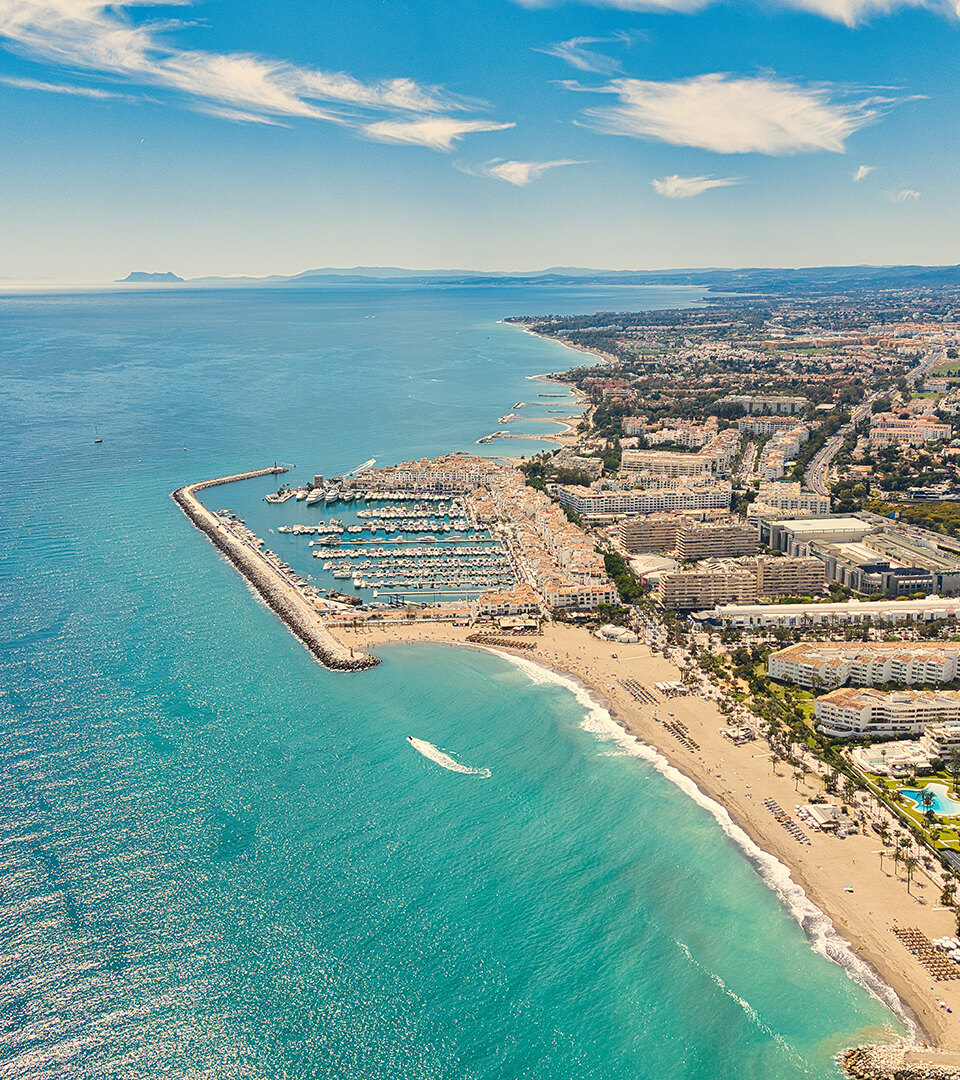
From Málaga and Marbella to quieter coastal towns, discover what defines the Costa del Sol and its best places to live.

For decades, the Costa del Sol has carried the nickname the "Spanish Riviera”, known for its Mediterranean coastline, luxury resorts, yachting lifestyle and some of southern Europe’s most sought-after property.
That international identity has now had half a century to develop. In 2026, the Costa del Sol celebrated 50 years since its tourism body began promoting the coast under one unified brand.
But the postcard version is only part of the story. This is also a working, lived-in coastline, shaped as much by Málaga’s city life and inland villages as by Marbella’s luxury market.
The Costa del Sol stretches for more than 150 kilometres along Málaga province’s Mediterranean coast, from the Maro-Cerro Gordo cliffs at Nerja to Punta Chullera in Manilva, near the Cádiz border.
There are 14 municipalities along the coastline: Nerja, Torrox, Algarrobo, Vélez-Málaga, Rincón de la Victoria, Málaga, Torremolinos, Benalmádena, Fuengirola, Mijas, Marbella, Estepona, Casares and Manilva.
Then there are the nearby inland municipalities of Benahavís, Ojen & Istán, which are also considered part of the wider Costa del Sol region.
The eastern coast around Nerja is generally quieter and more traditional. At its centre is Málaga city, the provincial capital, while further west lie the busier coastal towns of Torremolinos, Benalmádena and Fuengirola, followed by the major residential markets of Marbella and Estepona.
You will also see Sotogrande mentioned alongside the Costa del Sol, particularly on property and travel sites. Although it sits just beyond Manilva, within the province of Cádiz, it is closely connected to the western Costa del Sol and therefore considered alongside it from a lifestyle and property perspective.

Commissioned by the Turismo Costa del Sol.
Costa del Sol translates as ‘Coast of the Sun’, and the name is well deserved. The region enjoys more than 320 days of sunshine a year, helping to shape the outdoor lifestyle for which the coast is known.
The term itself is credited to Austrian hotelier Rodolfo Lussnigg, who used Costa del Sol in a tourism campaign in 1928. At the time, however, he was promoting the coast of Almería.
The name was later adopted by Málaga’s coastline and became firmly associated with the region during the rapid growth of international tourism in the mid-20th century. Málaga may not have invented the name, but it certainly made it famous.

Occidental simply means ‘western’, so Costa del Sol Occidental is the name used for the western part of the Costa del Sol.
It also extends inland to areas such as Benahavís, which explains why these places are considered part of the Costa del Sol despite not sitting directly on the shoreline.
The official Mancomunidad de Municipios de la Costa del Sol Occidental brings together the 11 municipalities of Benahavís, Benalmádena, Casares, Estepona, Fuengirola, Istán, Manilva, Marbella, Mijas, Ojén and Torremolinos.
Subscribe to our newsletter for engaging articles, exclusive content, and the latest updates.

Best for: luxury property, top-tier amenities, established residential areas, international schools, golf, restaurants and year-round living.
Marbella has one of the widest selections of prime residential areas on the coast, from the Golden Mile and Nueva Andalucía to Marbella East, Puerto Banús and San Pedro de Alcántara.
There is also considerable variety within those areas, including beachfront apartments, golf properties, gated communities and large private villas.
Marbella’s geography plays an important role in creating these very different residential settings
For buyers trying to narrow that choice down further, Panorama's individual Area Guides look at the Costa del Sol’s best neighbourhoods in much greater detail.
Take a look at our properties for sale in Marbella.
Best for: luxury property, privacy, mountain living, nature, views, golf and gated communities.
Set inland between Marbella and Estepona, Benahavís offers a quieter, more natural setting while remaining within easy reach of the coast.
Its large, hillside municipality is home to La Zagaleta, one of Europe’s most exclusive private residential estates. Elsewhere in Benahavís, El Madroñal and La Quinta offer their own distinct residential settings, with large plots, privacy and impressive mountain and Mediterranean views.
For buyers seeking luxury property with more space and a stronger connection to nature, Benahavís is one of the standout choices on the Costa del Sol.
You might be interested in: Properties for sale in Benahavís.
Best for: modern developments, coastal living and easy access to Marbella.
Estepona combines a traditional Andalusian town centre and long coastline with a growing choice of contemporary residential developments. Its beaches, marina, restaurants and pedestrianised centre give it a strong year-round appeal.
Its eastern side blends almost seamlessly into the Marbella and Benahavís property market, with established golf areas, beachfront communities and new developments making it a particularly strong option for buyers who want to remain close to Marbella.
Our selection of properties for sale in Estepona.
Best for: Mediterranean city living, culture, convenience and transport connections.
Málaga offers a vibrant city vibe to the living options along the Costa del Sol. Rather than a resort setting, it combines city beaches with a historic centre, more than 40 museums, renowned restaurants, shopping and a lively cultural scene.
It also offers some of the best transport connections in the region, with Málaga-Costa del Sol Airport, high-speed rail links and a walkable city centre. For buyers who want the Mediterranean lifestyle without giving up the energy and convenience of a major city, Málaga is a natural choice.
Best for: golf, marina living, privacy and large villas.
Sotogrande sits just beyond the western edge of Málaga, technically within the province of Cádiz, but is closely connected to the Costa del Sol from both a lifestyle and property perspective.
Known for its marina, championship golf courses and spacious residential areas, it offers a quieter and more private setting than many coastal towns. Property ranges from marina apartments to large villas on generous plots, making it particularly appealing to buyers looking for space, security and easy access to golf and the sea.
Take a look at our properties for sale in Sotogrande.

Yes. Although the Costa del Sol is famous as a holiday destination, it has a large permanent population and the infrastructure to support year-round living.
The climate makes year-round life particularly easy. Winters are mild, averaging around 17°C, while summer temperatures average around 31°C. Spring and autumn tend to bring warm days and milder evenings, providing an ideal climate for outdoor dining, walking and sports.
Residents also have access to an array of international schools, public and private healthcare, shops, restaurants, top sports facilities and established residential communities.
Connections are another major advantage. Málaga-Costa del Sol Airport provides extensive year-round international links. In 2025, the airport handled 26.76 million passengers and served 162 destinations.
Find out exactly how Málaga airport is a major advantage for property owners on the Costa del Sol.
The Costa del Sol has a sizeable permanent population. According to Spain’s National Statistics Institute (INE), the 14 coastal municipalities from Nerja to Manilva had a combined registered population of more than 1.38 million in 2025, with the 11 municipalities of the western Costa del Sol (Costa del Sol Occidental) accounting for around 612,000 residents.
Marbella alone had 173,420 registered residents at the beginning of 2026, including more than 62,500 residents of foreign origin from over 150 countries, reported by the city hall.
The Costa del Sol is also one of Spain’s most international coastal regions. A study published by the Diputación de Málaga in 2025 found that 88% of the foreign residents registered in Málaga province lived in its coastal municipalities. The largest foreign-born communities in the province were from the United Kingdom, Germany and Morocco.
The British community accounted for 53,413 registered residents, with particularly large concentrations in Mijas, Fuengirola and Marbella.
These figures show why so much of the Costa del Sol operates year-round, with an established demand for homes, international schools, healthcare, professional services and everyday amenities that extends well beyond the summer season.

The property market varies considerably across the Costa del Sol. An apartment in Málaga offers a very different lifestyle from a villa in Benahavís, or a beachfront home in Marbella, so choosing the right area is often the best place to start.
For buyers relocating from abroad, renting is often the most practical first step. It gives you time to experience different neighbourhoods, settle into life on the Costa del Sol and search for the right property to buy without rushing the decision.
Browse our selection of luxury long-term rentals or premium holiday rental options on the Costa del Sol.
The Costa del Sol is far from a single destination. From Málaga’s urban energy and Marbella’s established international residential market to the quieter coastal towns and inland communities that offer charm and history, each lends a different perspective on life in southern Spain.
That variety is one of its greatest strengths. City life, beachfront living, mountain views and greater privacy can all be found here, and all conveniently within easy reach of one another.
Panorama specialises in luxury property across Marbella, Benahavís and Estepona, with dedicated sales and rental departments covering apartments, townhouses, villas, new developments and exceptional homes.
The Costa del Sol is on Spain's southern Mediterranean coast in Andalucía and is principally associated with the coastline of Málaga province.
The Costa del Sol stretches for 150 kilometres along Málaga's Mediterranean coastline.
The best-known include Málaga, Torremolinos, Benalmádena, Fuengirola, Mijas, Marbella, Estepona and Nerja, alongside smaller coastal municipalities including Torrox, Algarrobo, Rincón de la Victoria, Casares and Manilva.
Benahavís is inland rather than directly on the coast, but it is widely considered part of the wider Costa del Sol residential market because of its close proximity to Marbella and Estepona.
Sotogrande is often included in Costa del Sol property searches, although geographically it lies just across the provincial border in Cádiz.
The Costa del Sol enjoys more than 320 days of sunshine a year, which is one of the reasons it is so popular for both holidays and year-round living.
It depends on the lifestyle you are looking for. Marbella offers an established international and luxury residential market, Benahavís greater privacy and mountain living, Estepona modern coastal living, and Málaga a true city lifestyle.
Yes. The combination of mild winters, international schools, healthcare, transport links, restaurants, beaches and established residential communities makes much of the Costa del Sol suitable for permanent living as well as holidays.

A visionary in PR and real estate, shaping Marbella’s success and legacy.