Like what you read?
Subscribe to our newsletter for engaging articles, exclusive content, and the latest updates.
Long before Marbella had its name, prehistoric communities, Phoenician traders, Romans and early Muslims were already shaping this Mediterranean coast.
· 9 min. read
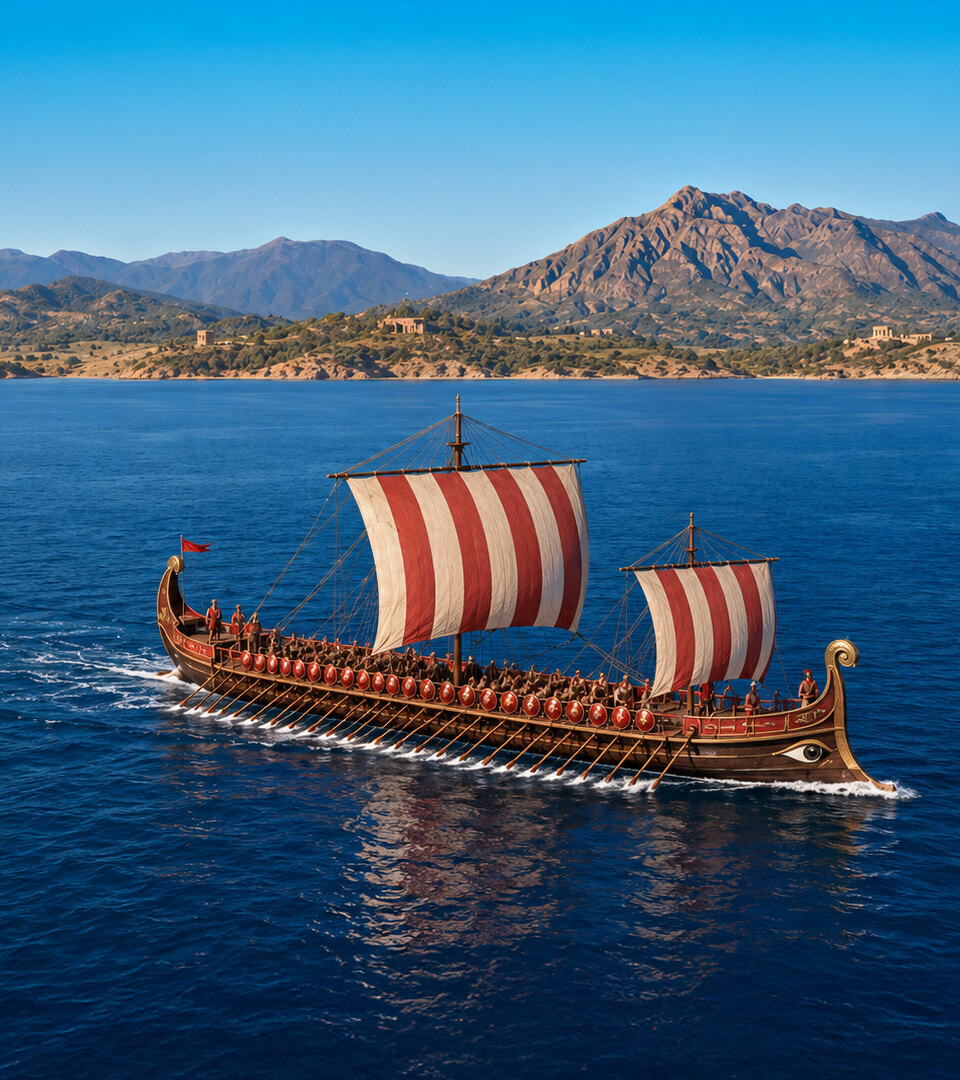
From prehistoric settlements and Phoenician traders to Roman villas and a fortified Muslim town, Marbella’s story began thousands of years before the city we know today.

Long before Marbella had its name, people were already living along this stretch of Mediterranean coast.
Over millennia came Phoenician traders, Roman settlers, early Christian communities and, eventually, the fortified Muslim town from which Marbella would begin to emerge.
Their traces can still be found across Marbella, in its archaeological remains, ancient foundations and the architectural details that form parts of the city today.

Marbella’s story technically starts hundreds of thousands of years before the Phoenicians or Romans arrived. Stone tools found at Coto Correa in Las Chapas point to Lower Palaeolithic activity, while later prehistoric evidence has been discovered in the caves and rock shelters of the Sierra Blanca foothills.
Among them are the Abrigos de Puerto Rico, a series of natural rock shelters where flint tools and other archaeological material have been found, and the nearby Pecho Redondo Cave, known for its prehistoric rock paintings. Both areas continued to be used during the Neolithic period, showing that people returned to these foothills over thousands of years.
By the Copper Age, communities were making greater use of the surrounding landscape, exploiting mineral resources and establishing settlements around the Guadaiza and Verde rivers. By the time Marbella entered written history, people had already been living in and around this landscape for millennia.

2,600–2,700 years ago, during the 7th and 6th centuries BC, Phoenician communities established a settlement on raised ground beside Río Real in Marbella East.
We do not know what the settlement was called. In fact, the name Marbella does not appear in surviving written sources until many centuries later.
The Phoenicians came from the eastern Mediterranean as part of a wider network of traders along the southern Iberian coast. Río Real offered easy access to the sea and a natural route inland, making it an ideal location for settlement and trade.
The remains visible at Río Real today include the stone foundations of rectangular houses, while amphorae and fragments of Greek pottery reveal commercial links that stretched well beyond the immediate coastline.
Fishing became central to the story. Marbella's municipal history records Phoenician activity in Río Real and Las Chapas, including trade with local populations and the production of salted fish.
The Romans would later expand this coastal industry, particularly the production and trade of garum, the intensely flavoured fermented fish sauce that became a staple across the Roman world.

2,100–2,200 years ago, during the 2nd century BC, Rome gradually took control of the Málaga coastline, which had previously been under strong Punic and Carthaginian influence.
As Roman control expanded, this stretch of coast became part of a much larger political and commercial system. Roads improved, settlements grew and villas appeared along the coast. Agriculture, fishing, mineral extraction and maritime trade all formed part of the local economy.
There is abundant evidence of Roman occupation across today's municipality, but less certainty about exactly how those settlements were organised or what they were called.
Rather than one clearly defined Roman city lying beneath modern Marbella, the evidence suggests a landscape of villas, industrial activity, burial areas and settlements distributed along the coast.
Some of the clearest Roman remains you can still see today, include the Roman Villa of Río Verde and the Roman Baths of Las Bóvedas near San Pedro Alcántara.

Roman remains have also been uncovered beneath the streets of Marbella itself, while Roman capitals can still be seen incorporated into the walls of the later castle.
Excavations around Calle Escuelas uncovered the remains of a monumental Roman building predating the fortress, while Roman ceramics have been found around Plaza de los Naranjos and a Roman tomb near Plaza de la Victoria.
Roman remains also survive across the municipality, from burials in Las Chapas and mining activity around Cerro Torrón and Cerro del Trapiche to pottery near San Pedro Alcántara and finds close to Puerto Banús.
Perhaps most striking of all are the surviving foundations of a Roman bridge at Puente Romano. The area still takes its name from that bridge, giving modern-day Puente Romano a direct link to Marbella’s Roman past.

What survives around Marbella in scattered fragments formed part of a much larger Roman world. To the east, Malaca, modern-day Málaga, developed as an important city with a theatre, busy trading activity and a strong fish-processing industry.
To the west, around 120 km from Marbella, Baelo Claudia at Bolonia near Tarifa became another important centre. Its position on the Strait of Gibraltar linked it directly with North Africa, including Tingis, modern-day Tangier.
Baelo Claudia’s surviving remains include a forum, temples, market, theatre, baths, aqueducts and an industrial quarter devoted to fish processing.
As the Roman world began to change, the rise of Christianity left a new mark on the Marbella coast.
1,500–1,600 years ago, during the 5th century AD, an early Christian community was worshipping near present-day San Pedro Alcántara.
The Basilica of Vega del Mar proves this in one of the clearest glimpses of this transition from the Roman world into the early Christian period.

The basilica had three naves and, unusually, two opposing apses. Very few comparable double-apse churches survive in the Iberian Peninsula.
Around the church lay an extensive cemetery, where approximately 200 burials have been excavated, spanning roughly the 3rd to 7th centuries AD.
Together, the basilica and cemetery show a community living through the gradual transformation of the Roman Mediterranean into the early Middle Ages.
Around 1,500 years ago, as the Western Roman Empire collapsed, life along the coast was entering a new era.
Coastal settlement declined and communities sought protection on higher ground, including Cerro Torrón,
Alicates and Nagüeles. For a time, settlement around Marbella became more dispersed.
Another transformation was coming.
Around 1,300 years ago, during the early medieval period, Muslim rule became established across much of the Iberian Peninsula.
The territories under Muslim control became known as al-Andalus, which at different times covered large parts of present-day Spain and Portugal. This period is also commonly described as Moorish Spain, although the population of al-Andalus was diverse, including people of North African, Arab and Iberian origin.
Over the centuries that followed, settlement around Marbella gradually shifted towards the area where the Old Town stands today.
A couple of hundred years later, during the 10th century, Marbella’s castle, or alcazaba, was built. Defensive walls later enclosed the growing town, with gates including the Puerta del Mar, Puerta de Ronda and Puerta de Málaga.

For centuries, communities had occupied sites scattered between the rivers, hills and coastline. Now, a more recognisable urban centre was forming around the fortress.
Remarkably, the new Marbella also incorporated pieces of the old Roman capitals and other building materials that were reused in the medieval castle and can still be seen embedded within its towers and walls today. One civilisation quite literally built into another.

Also dating from the 10th century, Montemayor Castle stood above present-day Benahavís at 579 metres above sea level, overlooking settlements and lands connected to Marbella. From its commanding position, views stretch across 100 km of coastline. The same panorama can be enjoyed today by those who make the steep hike up to the castle ruins.
Local legend also connects the castle with the name Benahavís itself. An Arab king is said to have lived at Montemayor, with the town later taking its name from his son. The name Benahavís is often linked to Ben al-Havis, interpreted as “son of Havis”, although the exact origin of the name is uncertain.
By the mid-12th century, around 1154, the town we now know as Marbella had entered the written record. The geographer al-Idrisi described it as a small but well-populated town. During the Middle Ages, its name was recorded in several different forms, including Marbela, Marvella and Marabela, before the modern spelling became established.
On 11 June 1485, Marbella surrendered to Ferdinand the Catholic. The ceremonial handover of the city’s keys is believed to have taken place at the Cruz del Humilladero on Calle Málaga, just outside the town walls.
The surrender marked the end of Muslim rule in Marbella and brought the town into the Crown of Castile. New Christian settlers arrived, and Marbella’s appearance gradually changed with them.
During the 16th century, Plaza de los Naranjos was created within the former walled town, alongside some other lesser known landmarks, including the Antiguo Hospital de San Juan de Dios, Hospital Bazán and the former Convento de la Trinidad reflected Marbella’s new Christian era. Hospital Bazán now houses the Museo del Grabado Español Contemporáneo.
For more places to explore nearby, see our guide to Marbella’s best attractions.
Post 1485, Marbella entered another long period of change, and over the following centuries, agriculture, fishing and local trade were central to life in the town.
The next major industry pivot came in the 19th century.
Its rich iron deposits helped transform the town into one of Spain’s pioneering industrial centres. The ironworks of La Concepción and El Ángel placed Marbella at the forefront of the country’s emerging iron and steel industry. In 1844, they produced around 72% of the iron consumed in Spain.
By the end of the century, that industrial boom had faded and Marbella remained largely an agricultural and fishing town. Mining continued into the 20th century, but another transformation was already on the horizon.
From the 1950s, pioneers such as Ricardo Soriano and Prince Alfonso von Hohenlohe helped usher in Marbella’s new era of international tourism. The Marbella Club opened in 1954, followed by the development of Nueva Andalucía and the opening of Puerto Banús in 1970, the same year Panorama Properties was established in Marbella.
You can read more about this period in The history of Puerto Banús and Nueva Andalucía.

Continue the story into Marbella’s modern era: How Panorama began in Marbella in the 1970s.
Subscribe to our newsletter for engaging articles, exclusive content, and the latest updates.

Ensures smooth operations at Panorama with unmatched organisation and enthusiasm.