Like what you read?
Subscribe to our newsletter for engaging articles, exclusive content, and the latest updates.
Chris Clover recalls the people, plans and early investors behind the creation of Sierra Blanca.
· 5 min. read
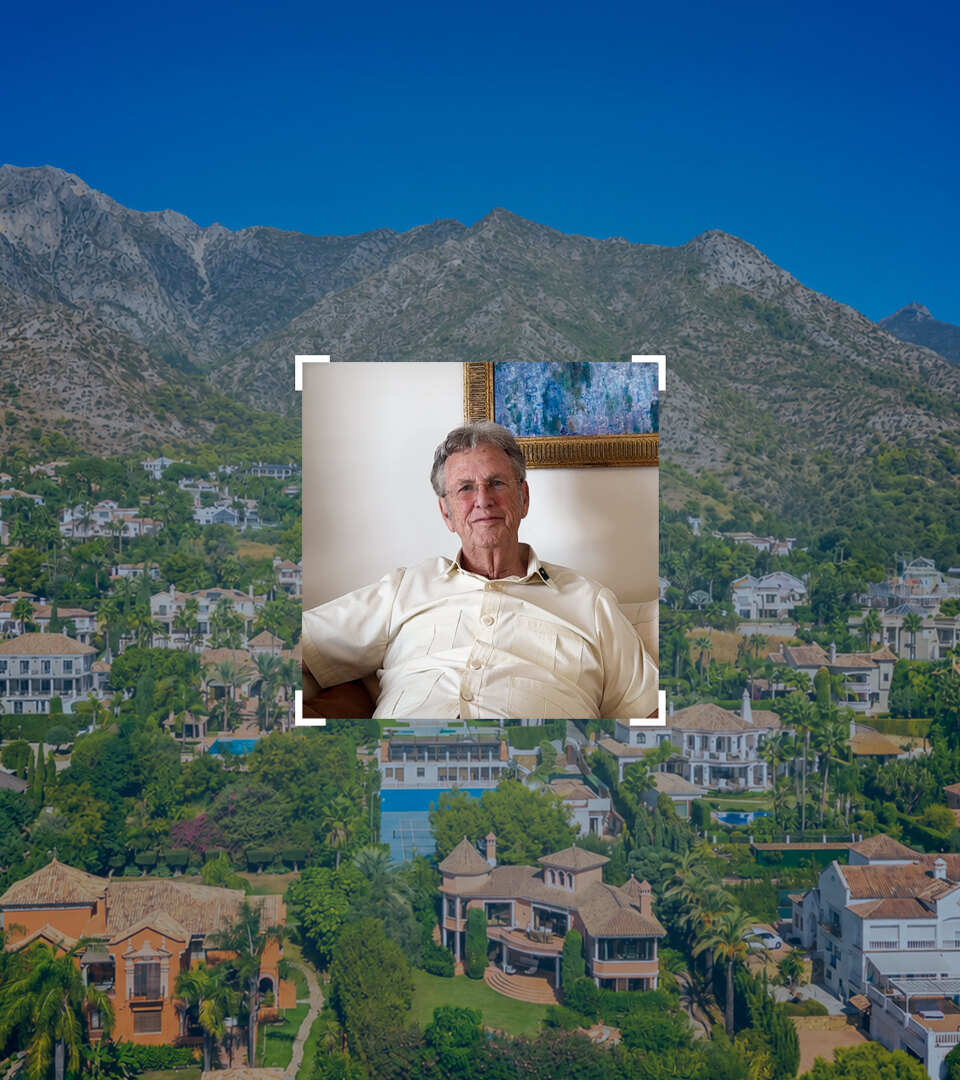
A chance encounter in Panorama’s Marbella office marked the beginning of an extraordinary chapter in the history of Sierra Blanca.

Perhaps the most exciting part of being a real estate agent is meeting the remarkable people who walk into our lives, especially here in Marbella.
In 1980, Panorama’s office was located on Avenida Ricardo Soriano, opposite the old Portillo bus station. One day, an elegant older lady came in, said hello and walked directly towards a large aerial photograph of Marbella hanging on the wall.
She pointed to an enormous stretch of land north of Nagüeles and declared:
“This is my land!”
Elizabeth Brockman
Her name was Elizabeth Brockman. She was an American of Russian origin, a Juilliard-trained pianist and a passionate champion of the arts. Together with her husband, David Brockman, a highly regarded New York tax attorney, she had already played a part in helping to save Carnegie Hall from demolition.
In Marbella, David and Elizabeth were generous, cultured and, in the best possible way, unforgettable.


Several years before Elizabeth first walked into Panorama’s office, the Brockmans had acquired approximately 1.2 million square metres of land, almost 300 acres, extending across the mountainside above Marbella.
The estate commanded remarkable views across the town and the Mediterranean.
They had bought the land together with German industrialist Rudolf Munemann, who was represented locally by his son, Connie. The Munemann family lived near the Marbella Club in a beautiful old house known as El Gazapo.
You might be interested in: The beginnings of the Marbella Club.
As my friendship with David and Elizabeth developed, they asked whether Panorama could help them sell the property. The Brockmans and Connie Munemann agreed on an asking price of $3.5 million.
It was a vast tract of undeveloped land, but its position, scale and views made its potential immediately apparent.
Subscribe to our newsletter for engaging articles, exclusive content, and the latest updates.
Not long afterwards, a Kuwaiti client of ours fell in love with the site and signed an option agreement to purchase it for $3 million, subject to planning permission being granted.
Architects José Ignacio Domínguez and Antonio Ortiz were appointed to prepare the Partial Plan at the Kuwaiti client’s expense. That plan would ultimately determine how the land could be divided, developed and integrated into Marbella.
The process was far from straightforward.
Planning progressed slowly, and there was opposition from the Green Party at the time. The Kuwaiti client eventually withdrew from the purchase, leaving the future of the estate uncertain once again.
Following this, the Brockmans bought out their German partners and continued pursuing the approval needed to move the project forward.

In 1985, the Partial Plan was finally approved.
It provided for approximately 300 single-family plots across 160 net acres, equivalent to around 650,000 square metres. The remainder of the original estate was allocated to roads, green zones and the obligatory land transferred to Marbella Town Hall as part of the planning process.
The approval established the basic form of the residential area that would become Sierra Blanca.
However, securing planning permission was only part of the challenge. Roads, utilities and the wider infrastructure still needed to be created, and raising the necessary investment was not easy.
One of the early investors was Pedro Rodríguez, founder of Sierra Blanca Estates, who purchased shares in the Brockmans’ company in 1986.
In 1989, he exchanged his shares for land and began constructing what were, at that time, some of the most beautiful homes known in Marbella.
It was the beginning of an extraordinary success story that continues today through his sons, Carlos and Luis Rodríguez, who have become two of Marbella’s leading developers.
The arrival of these first investors and homes began transforming the approved plans into a genuine residential neighbourhood on the slopes above the town.
What had once been an immense private estate was gradually becoming Sierra Blanca, one of Marbella’s most recognisable hillside communities of Marbella’s Golden Mile.
Elizabeth Brockman also left a much more personal signature on Sierra Blanca.
A devoted musician, she named each of the development’s roads after one of the world’s great composers. The names found throughout Sierra Blanca today reflect her love of classical music and the arts.
Elizabeth also helped to organise, with a great deal of support, the first concerts held in the old Nagüeles quarry beneath La Concha.
The quarry had previously supplied stone for the construction of Puerto Banús.
Many years later, it would become the setting for the Starlite Festival, continuing the area’s long connection with music and live performance.

Looking back, the history of Sierra Blanca is about much more than the planning and development of a large estate.
It is also the story of the people behind it: Elizabeth and David Brockman, the Munemann family, the architects who prepared the Partial Plan, the investors who financed its infrastructure and the developers who began creating its first homes.
For me, it began with an elegant lady walking into Panorama’s office, pointing towards a mountainside on an aerial photograph and announcing, quite simply:
“This is my land.”
Decades later, the name Sierra Blanca is firmly established within Marbella, but its beginnings remain one of the most fascinating stories I have encountered during my career in real estate.
To learn more about this prestigious area: Sierra Blanca: Marbella’s most exclusive residential enclave.


Christopher has over 55 years of experience in Marbella real estate.